If you’re thinking about buying an online business, you’ll most probably run into two main types of deals: On one side, you’ve got content sites (blogs, affiliate sites, and media brands making money from traffic). And on the other side, you’ve got e-commerce stores (Shopify brands, product businesses, and DTC companies moving physical inventory).
At a glance, both digital assets look attractive; both can generate six or seven figures a year and are sold at multiples. Moreover, both types of business promise you “location freedom.” But underneath the surface, they are wildly different types of businesses. To decide which one to acquire, you should look into more than just profit comparison. You should consider additional aspects like lifestyle, risk, capital, and temperament.
Let’s break down how the businesses compare across these key areas.
What Is A Content Site? (Affiliate, Display Ad & SEO-Based Online Businesses Explained)
A content site makes money from attention. It publishes articles (usually SEO-driven), attracts organic traffic from Google, and then monetizes it (the traffic) through ads, affiliate offers, or sometimes digital products. That’s it. There’s no warehouse. No shipping. No refunds. No supplier calls at 11 pm.
Most content sites have a lean structure. They involve a couple of freelance writers, maybe an editor, some SEO tools, and hosting.
The margins for these businesses are typically high, often 60–85% net, because there’s no cost of goods sold involved. Once the content ranks, it just sits there generating revenue. But here’s the tradeoff: you’re usually heavily dependent on Google, so if traffic dips, your revenue dips as well.
How Content Sites Are Valued:
Buyers typically pay around 30x–40x monthly net profit. So, if a site earns $10,000 a month, you’re looking at roughly $300,000–$400,000.
The multiple is usually based on the following:
How stable the traffic has been
Whether revenue is diversified
How concentrated it is around certain keywords
Whether there’s an email list or owned audience
The cleaner and more diversified the traffic, the higher the multiple. However, traffic concentration risk is always high.

Trend Hijacking helps you Reclaim Control over your Financial Destiny
Most successful professionals and investors like you never actually own real assets that cashflow at the pace you want.
You earn well.
You invest passively.
But you never truly control something scalable.
We've created a solution: a FREE guide that shows you exactly how investors are using acquisitions to outperform stocks and real estate, all without needing any experience.
What Is An E-Commerce Store? (DTC, Shopify & Product-Based Business Models)
An e-commerce store makes money by selling products. The most common e-commerce business models today include:
Private label products
A niche DTC brand
Dropshipping
Hybrid Amazon + Shopify
Subscription products
Unlike content sites, revenue for e-commerce stores is tied to transactions, not traffic volume alone. And that creates a very different dynamic.
A typical e-commerce store has more moving parts. This includes inventory, suppliers, customer service, Ad campaigns, returns, fulfillment, and cash flow management.
Margins for e-commerce stores are typically lower, often 15–35% net, but the total revenue figure can be much higher.
Where a content site might do $500k in revenue with huge margins, an e-commerce brand might do $3M in revenue at thinner margins.
How E-Commerce Stores Are Valued (Annual Multiples & Brand Premiums)
E-commerce store valuation is usually around 2.5x–4.5x annual net profit. This means an online store making $300,000 a year might sell anywhere from $750,000 to $1.35M, depending on brand strength and risk.
Multiples can go up in any of the following scenarios:
There’s strong brand equity
Traffic isn’t overly dependent on one channel
Repeat purchase rate is high
SOPs are documented
The owner isn’t required for daily operations
In simpler words, the more “real business” an e-commerce store feels like, the higher the multiple becomes.
Content Site Vs E-Commerce Profit Potential: Which Business Model Makes More Money?
This is where people get emotional… Content sites feel safe and clean, while e-commerce stores feel exciting and scalable.
But let’s look at this with a sober mood.
Content sites usually win on margins. Once traffic is steady, cash flow becomes predictable, and there’s quite little overhead.
E-commerce wins on the ceiling. You can increase ad spend, launch new SKUs, raise AOV, and expand internationally. There are more levers to pull here.
However, scaling an e-commerce business requires capital. But scaling content? That requires time.
Overall, an e-commerce business is financially leveraged while a content site is patience-leveraged.
Are Content Sites or E-Commerce Stores Riskier Investments?

If you’re an investor, you also want to understand the risk comparison between these two types of business. As experienced investors will agree, this matters more than the profit section.
Here’s how the two businesses compare in major areas:
Traffic Risk: Google Algorithm Updates vs Paid Ad Volatility
As we said earlier, content sites are often heavily dependent on Google. This means an algorithm update can cut traffic by 40% overnight. This is something that has happened before and is likely to happen again as Google continues to roll out algorithms every new year.
E-commerce brands, on the other hand, rely on paid ads plus some organic traffic. Their risk is different. The Ad costs fluctuate, and Ad Accounts sometimes get restricted. Not forgetting that customer acquisition costs rise.
While content risk is algorithmic, the e-commerce risk is advertising and operational.
Operational Risk: Supply Chain, Inventory & Team Complexity
Content sites are operationally simple, as you just need content writers and ongoing SEO maintenance. That’s quite manageable.
But when it comes to the e-commerce side of things, there are more ways to break. Think about supplier delays, inventory miscalculations, refund spikes, logistics issues, and cash tied up in stock.
If you’re not ready to manage complexity, e-commerce will feel heavy on you.
Capital Risk: Inventory Exposure vs Asset Depreciation
Content sites don’t tie up capital in inventory, so you won't be waking up to $100k sitting in a warehouse.
But an e-commerce store absolutely can. And inventory mistakes hurt. If you buy too much stock, it can kill cash flow. Also, buying too little can kill momentum.
The beauty of content sites is that they rarely face this kind of capital exposure.
How Much Money Do You Need to Buy A Content Site Vs E-Commerce Store?
Content sites often have lower entry points. You can comfortably enter the market at $50k–$500k. E-commerce deals tend to start higher, and more importantly, they require working capital beyond the purchase price.
If you buy a $500k e-commerce business, you may need another $100k–$200k for inventory and ad spend buffer. That working capital requirement changes the equation significantly.
Trend Hijacking helps you Reclaim Control over your Financial Destiny
Most successful professionals and investors like you never actually own real assets that cashflow at the pace you want.
You earn well.
You invest passively.
But you never truly control something scalable.
We've created a solution: a FREE guide that shows you exactly how investors are using acquisitions to outperform stocks and real estate, all without needing any experience.
Time Commitment & Lifestyle Differences: Passive Income Website vs Active E-Commerce Brand

Content sites can become semi-passive. Once stabilized, you might spend 5–10 hours per week overseeing writers and checking rankings.
E-commerce is rarely passive unless heavily systematized. You’ve got to make more daily decisions. There are often more fires and more moving pieces.
If you want simplicity, a content site wins. But if you enjoy building brands and optimizing funnels, e-commerce is more engaging.
Exit Strategy Comparison: Which Online Business Is Easier to Sell?

Content sites are easier to understand as they’ve got clean financials and clear traffic metrics. But buyers are cautious about SEO volatility. E-commerce brands, on the other hand, can command larger exits, especially if brand equity and customer lists are strong.
Strategic buyers often prefer brands over traffic assets, so exits in e-commerce can be bigger. But serious buyers will conduct deeper due diligence to try to uncover any hidden problems in your business.
Who Should Buy A Content Site?
Content sites are an ideal investment for you if you’re a first-time buyer, an investor focused on cash flow, and comfortable with SEO. It is also a good choice for those with lower risk tolerance. These websites are simpler to operate and easier to forecast.
Who Should Buy An E-Commerce Store?
E-commerce is best suited for operators who enjoy building systems, paid media experts, brand builders, and investors comfortable with higher volatility. It’s a more active business model with more upside.
Pro Tip: Some smart investors combine both types of assets. They acquire a content site and eventually launch their own products into that audience. This way, they control traffic and the product. Margins expand, and valuation improves while platform risk decreases. This strategy takes time, but it’s powerful when executed well.
Final Takeaway
When it comes to deciding on buying a content site vs e-commerce store, there isn’t a universal winner. Content sites offer you simplicity, high margins, and lower operational stress. E-commerce stores offer you a larger upside, stronger brand equity, and faster scaling potential.
We advise you against choosing your investment based on excitement. The best acquisition for you is not the one with the biggest theoretical return but one that fits your capital, risk tolerance, skillset, and lifestyle.
Ready To Acquire A Scalable E-Commerce Business?
If you're looking for predictable cash flow, content sites can make sense.
But if you're aiming for real leverage (i.e., brand equity, scalable revenue, meaningful exit potential), e-commerce is where serious upside lives.
The challenge isn’t finding deals but spotting the right deal and structuring it properly. That’s what our Smart Acquisition is built for. We work alongside investors to help them:
Identify high-potential e-commerce brands
Conduct deep strategic analysis
Structure smarter, safer acquisitions
Build post-acquisition scaling plans
If you're ready to acquire an e-commerce business the right way, let’s talk.




A Done-For-You E-commerce Business
Discover how we Build, Launch, and Scale a 6-figure/month Business for You
Learn more
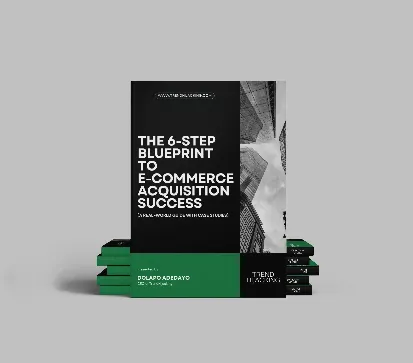
The 6-Step Blueprint to E-Commerce Acquisition
See how we Acquire, Convert, and Scale with Real Case Studies to Prove It.
You May Also Like


Join investors, Entreprenuers and Professionals like you building wealth through Ecommerce acquisitions, with the experts managing every step.
Start with our 14-day Free Business Acquisition Launch, where we show you exactly how we operate and give you a curated list of businesses tailored to your budget, goals, and lifestyle.