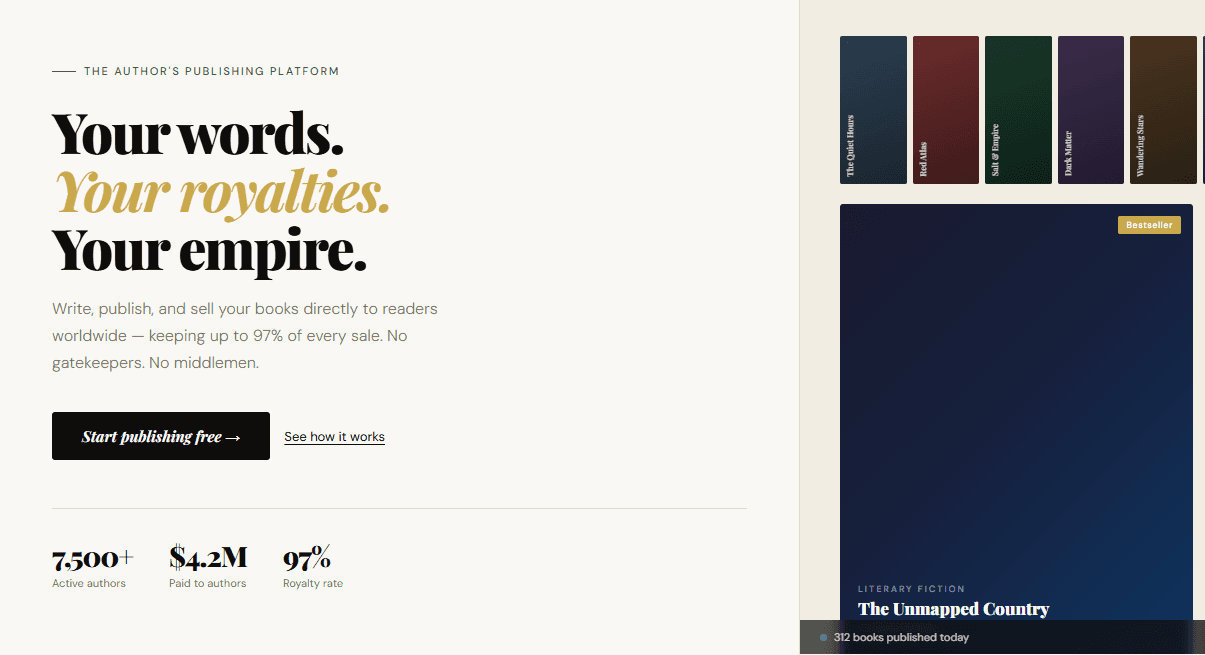

Executive Snapshot
Purpose: Quick clarity for internal decision-making
Business model: Hybrid (B2C + B2B-style service platform within the Amazon / Amazon KDP ecosystem)
Primary product category: Digital publishing launch services (self-publishing infrastructure + AI-powered book creation software)
Geography focus: Primarily U.S.-based author market (operations headquartered in Hong Kong)
Year founded: 2024 (based on stated site age of 2 years)
Initial Investment Thesis
Highly profitable, asset-light digital launch platform operating in the expanding self-publishing market, with strong margins, repeat customer behavior, and upside from integrated AI publishing SaaS.
Initial Concern Flag
Heavy reliance on the Amazon KDP ecosystem and paid acquisition channels; unclear brand defensibility and potential overstatement of AI/software capabilities warrant deeper technical and customer validation.
Market & Demand Signals
Category overview
The online business operates within the global self-publishing services and creator economy infrastructure market, specifically focused on launch optimization and visibility services for authors using platforms like Amazon KDP. This category sits at the intersection of digital services, online education, and creator monetization tools.
Market size & growth trajectory
The global self-publishing market is estimated to reach ~$6.1B+ by 2033, growing at ~15–17% CAGR, driven by increased accessibility to publishing tools and global creator participation.
The adjacent “publishing services” layer (editing, marketing, launch support) represents a multi-billion-dollar subsegment and is expanding alongside author growth.
Self-published titles have grown significantly over the past decade, with millions of new titles released annually on platforms like Amazon.
Search demand trends (Google Trends signals)
Search interest for terms like “Amazon KDP,” “self-publishing,” and “publish a book” shows consistent long-term growth, with periodic spikes tied to new income trends, side hustles, and AI-driven publishing waves.
Demand is cyclical but not declining.
Keyword volume indicators
High-intent keywords include:
“self publish book”
“Amazon KDP income”
“book marketing services”
These keywords are highly competitive, indicating strong commercial intent and willingness to pay for outcomes.
Seasonality vs evergreen demand
Demand is largely evergreen, as new authors enter the market daily.
However, there are seasonal spikes around:
New Year goal-setting periods
Mid-year productivity cycles
Holiday publishing windows
Problem urgency (essential vs discretionary)
Primarily discretionary, but becomes highly urgent post-publication, when authors need visibility, rankings, and reviews to succeed.
Cultural/macro tailwinds
Growth of the creator economy and digital entrepreneurship
Rising interest in passive income streams
AI lowering barriers to content creation
Increased global access to publishing platforms
Regulatory shifts impacting demand
Platform dependency risk:
Policy and algorithm changes within Amazon KDP
Increasing scrutiny on low-quality or AI-generated content
Trend dependency vs timelessness
Self-publishing is structurally durable, but tactics (e.g., AI books, low-content publishing) are trend-sensitive.
→ Market attractiveness score: Strong
→ Demand durability assessment: High long-term demand with moderate platform and trend dependency
Product–Market Fit Indicators
Goal: Assess whether the business clearly solves a defined problem for a specific audience and demonstrates credible product–market fit.
Value proposition clarity
The e-commerce store’s value proposition can be summarized as:
A systemized launch platform that helps self-published authors gain visibility, rankings, and sales on Amazon through structured, done-for-you launch packages.
The offering is outcome-driven and easy to understand.
Core customer persona
Primary segments include:
Independent authors (first-time and experienced)
Digital entrepreneurs seeking publishing-based income
U.S.-focused customers operating within the Amazon ecosystem
Repeat publishers releasing multiple books annually
Secondary segment:
AI-assisted authors scaling book production
Differentiation
Differentiation is primarily operational rather than proprietary:
Key differentiators include:
Structured, pre-packaged launch tiers
Documented SOP-driven delivery model
Claimed scale (7,500+ authors served)
Integrated AI publishing software (creation → launch ecosystem)
Focus on systemization vs freelance services
However, there is limited evidence of proprietary IP or exclusive technology.
Commoditization risk
High.
Many competitors offer similar launch and marketing services within the KDP ecosystem.
Competitive advantage depends heavily on:
Marketing execution
Customer acquisition funnels
Brand trust and perceived results
Ease of customer adoption
Adoption barriers are very low.
Clear packages
No technical skills required
Strong appeal to beginners
Repeat usage potential
Moderate to high.
Authors publishing multiple books create repeat demand
However, each launch is inherently a one-off event
Subscription / refill logic
Currently transactional, but strong potential for:
Subscription-based launch support
SaaS monetization via AI tools
Ongoing marketing services
Price positioning vs competitors
Likely mid-to-premium tier within KDP service providers, justified by systemization and bundled services.
Premium justification
Premium positioning is supported by:
Done-for-you convenience
Structured workflows
Perceived track record
Inclusion of AI software
However, true premium value depends on verified results and customer outcomes.
→ PMF confidence level: Moderate–Strong
Clear problem and strong demand, supported by existing customer base, though partially marketing-driven.
→ Differentiation strength: Moderate
Strength lies in operational systems and funnel execution rather than proprietary or defensible IP.
Website & Conversion Infrastructure
Goal: Evaluate whether the ecommerce infrastructure can reliably convert traffic into revenue and support scalable paid acquisition.
Website speed & UX quality
The e-commerce business operates on a Shopify-style ecommerce framework, commonly used for direct-response digital product sales. The infrastructure prioritizes simplicity, speed, and rapid checkout over deep content or brand storytelling.
The site layout follows typical high-conversion patterns:
Clear product tiers (Silver, Gold, Diamond)
Benefit-driven headlines focused on outcomes (rankings, visibility)
Minimal navigation to reduce distraction
Direct add-to-cart flow
Speed performance appears solid due to lightweight pages, though reliance on scripts (tracking, upsell apps) may slightly affect load times. Overall UX is conversion-optimized but shallow, with limited educational depth.
Mobile optimization
The site is fully mobile-responsive, which is critical given reliance on paid traffic channels.
Key strengths:
Large CTA buttons
Simplified product pages
Fast mobile checkout flow
The structure aligns well with impulse purchase behavior from Facebook/YouTube traffic.
Visual credibility & brand consistency
Visually, the brand presents a clean but functional, non-premium identity.
Strengths:
Consistent color scheme
Structured product presentation
Weaknesses:
Limited brand storytelling or authority positioning
No strong founder presence or institutional credibility
Heavy reliance on marketing claims rather than proof
External signals (e.g., Trustpilot reviews) introduce credibility concerns, which may weaken perceived trust.
SKU count & catalog structure
The catalog includes approximately:
30–50 SKUs
Primarily variations of launch/review packages
Structure:
Tiered offers (Silver / Gold / Diamond)
Volume-based packages (10, 25, 50+ reviews)
Multi-book bundles
This modular, standardized catalog supports scalability and simplifies decision-making.
Average Order Value (AOV)
Estimated AOV: $300–$600+
Driven by:
Tiered pricing
Bundle upgrades
Multi-book purchases
This is significantly higher than typical ecommerce, reflecting a service-based model.
Estimated conversion rate
Not publicly disclosed. However, based on:
Direct-response design
Paid acquisition dependency
Estimated conversion rate: 2–5%
This aligns with high-intent service funnels.
Upsell/cross-sell structure
The site incorporates strong monetization mechanisms:
Tier upgrades (Silver → Gold → Diamond)
Bundle incentives (multiple books)
Add-on services
These are embedded directly into product selection rather than post-checkout flows.
Bundling logic
Bundling is a core revenue driver:
Higher volume = discounted pricing
Multi-book packages
Bonus inclusions (e.g., marketing assets)
This structure effectively increases AOV while simplifying choices.
Trust signals (reviews, certifications, UGC)
On-site trust signals include:
Testimonials
Outcome-based claims
Standard checkout security badges
External signals present mixed sentiment:
Trustpilot rating ~4.1★ with polarized feedback
Positive: delivery of promised services
Negative: concerns about quality, expectations, and review authenticity
Some users question compliance with Amazon policies, which introduces reputational risk.
Technical issues visible publicly
No major technical failures observed. However:
Limited transparency (team, case studies, proof of results)
Potential compliance ambiguity within Amazon ecosystem
Heavy reliance on front-end marketing vs backend credibility
Checkout flow friction
Checkout is streamlined and optimized:
Simple cart → payment flow
Clear pricing and packages
Minimal steps
Potential minor friction:
Ambiguity in service expectations (what is guaranteed vs not)
Output
→ Conversion infrastructure rating: Moderate–Strong
The business has a highly effective direct-response conversion system with strong AOV mechanics and scalable funnel design. However, credibility gaps and mixed external reviews reduce trust and may limit long-term conversion efficiency.
→ Quick-win optimization opportunities
Add verified case studies with measurable results
Improve transparency (team, process, compliance clarity)
Strengthen trust signals (video testimonials, real author outcomes)
Introduce educational funnel (lead magnet → nurture → conversion)
Clarify service guarantees vs expectations to reduce refund friction
Overall, the infrastructure is built for short-term conversion efficiency, but requires trust and brand depth improvements to sustain long-term scale.
Traffic & Distribution Footprint
Goal: Understand where demand originates, how customers reach the business, and how resilient the traffic model is if acquisition channels shift.
Estimated traffic volume
The business does not publicly disclose exact traffic metrics. However, based on available financials:
Monthly revenue: ~$98,340
Estimated AOV: $300–$600
Implied monthly orders: ~160–325
Assuming a typical service funnel conversion rate of 2–5%, estimated monthly traffic likely falls between:
3,000–12,000 visitors/month
Traffic is likely highly correlated with ad spend (~$18.8K/month), indicating a performance-driven acquisition model rather than organic demand capture.
Primary channels (Paid / Organic / Social / Marketplace)
1. Paid Acquisition (Primary Driver)
The business relies heavily on paid channels:
Meta Ads (Facebook / Instagram)
Likely YouTube Ads (aligned with video funnel strategy)
Possible Google Ads (high-intent “KDP” keywords)
This is consistent with direct-response funnels targeting authors seeking fast results.
2. Social Media (Supporting Channel)
Facebook presence: ~500+ followers
YouTube: ~8,500 subscribers via Massimo The Sensei of Publishing
Content appears educational/promotional, likely used to:
Build authority
Warm audiences
Support paid funnels
However, organic reach appears modest relative to revenue scale.
3. Community / Ecosystem Traffic
Facebook group engagement (author communities)
Word-of-mouth within KDP ecosystem
This likely contributes to repeat and referral traffic, though not a primary driver.
4. Organic / SEO (Limited)
Minimal evidence of strong SEO presence
Low domain authority footprint
No visible content marketing engine
Organic traffic is likely low and underdeveloped.
5. Marketplace Traffic (Indirect Dependency)
While not selling on marketplaces, the business is structurally dependent on:
Amazon
Amazon KDP
Demand originates from authors operating within these ecosystems.
Channel concentration risk
High concentration around paid acquisition:
Majority of revenue tied to ad performance
Limited organic or inbound demand
Advantages:
Fast scalability
Predictable CAC modeling
Risks:
Revenue volatility if ad performance drops
Creative fatigue and rising CPCs
Platform dependency risk (Meta, TikTok, Amazon, Google)
Critical dependencies:
Meta Ads → primary demand generation
Amazon KDP → core customer ecosystem
Google (search intent capture, if used)
Key risks:
Ad account bans or rising costs
Algorithm changes
Amazon policy enforcement (especially around reviews/launch tactics)
This creates dual dependency risk (ads + platform ecosystem).
International vs local reach
Operational base: Hong Kong
Primary market: U.S. authors
The model is geographically flexible (digital delivery), allowing:
Expansion into UK, Canada, Australia
Potential global scaling
Currently, demand appears U.S.-centric.
SEO footprint strength
SEO presence is weak:
Limited content strategy
No visible authority blog or resource hub
Low discoverability outside paid channels
This represents both a weakness and an opportunity.
Marketplace presence (Amazon, Etsy, etc.)
No direct marketplace selling.
All revenue is generated via the owned storefront (the business website).
However, demand is indirectly sourced from Amazon’s ecosystem, making it a dependency rather than a channel.
Direct vs intermediary sales ratio
~100% direct-to-consumer
No intermediaries or third-party platforms
Benefits:
Full margin control
Customer data ownership
Retargeting capability
Output
→ Traffic fragility score: Moderate–High
The business is highly dependent on paid acquisition and the Amazon ecosystem. While scalable, revenue is sensitive to ad performance and platform policy changes.
→ Channel diversification strength: Moderate–Low
Multi-platform ads provide some diversification, but lack of strong organic, SEO, or owned audience channels limits resilience. Significant upside exists in building inbound traffic and brand equity.
Marketing & Customer Acquisition
Goal: Evaluate whether growth is driven by a structured marketing system or opportunistic advertising, and assess the scalability of the brand’s acquisition engine.
Paid ad presence (Meta / YouTube / Google)
The business relies heavily on performance marketing as its primary growth engine.
Based on available data:
Monthly ad spend: ~$18,865
Channels likely include:
Meta Ads (Facebook / Instagram)
YouTube Ads (aligned with video funnel and creator presence)
Google Ads (high-intent KDP keywords)
The presence of a YouTube channel (Massimo The Sensei of Publishing) suggests video-led acquisition funnels, often used for high-ticket service conversion.
This indicates a structured, intentional paid acquisition system, not opportunistic spend.
Creative sophistication level
Creative strategy appears direct-response focused, emphasizing:
Outcome-driven messaging (“rank your book,” “get visibility”)
Authority positioning (publishing expertise)
Educational hooks (how-to content, publishing insights)
Compared to ecommerce brands, creative is more info-product / service funnel oriented, likely including:
Webinar-style or long-form video ads
Testimonials and case-based narratives
Problem-solution frameworks
However, there is limited evidence of high-end brand storytelling or premium positioning, suggesting optimization for conversion rather than brand equity.
Funnel depth
The funnel appears moderately to highly developed:
Top of funnel:
Paid ads driving to landing/product pages
Educational content (YouTube) warming audiences
Mid funnel:
Retargeting via Meta/Google
Likely email capture (though not heavily emphasized publicly)
Bottom of funnel:
Direct checkout (productized services)
Email remarketing (low cost: ~$299/month suggests active use)
The model leans toward short funnels (click → purchase) rather than long nurture sequences.
Email list size
Exact size not disclosed. However:
Active email spend indicates list usage
Likely includes past buyers + leads
Given 7,500+ customers served, estimated list size could be 5,000–15,000+ contacts
This is a moderate retention asset, but not a dominant growth channel.
Organic social engagement quality
YouTube: ~8,500 subscribers
Facebook: limited engagement footprint
Content exists but does not appear to be a major acquisition driver.
Organic presence is supportive, not foundational.
User-generated content (UGC)
UGC appears limited:
Testimonials exist, but mostly controlled/on-site
Lack of strong public author success stories or viral case studies
This weakens social proof depth and organic amplification.
Influencer presence
No clear evidence of a structured influencer or affiliate ecosystem.
This is notable given:
The creator economy nature of the niche
Opportunity to leverage publishing educators
Influencer partnerships remain an untapped growth lever.
CAC indicators (if available)
Monthly ad spend: ~$18,865
Monthly revenue: ~$98,340
→ CAC ratio ≈ 19% of revenue
This is highly efficient for a service business with 70% margins, indicating:
Strong unit economics
Profitable acquisition engine
However, sustainability depends on ad performance stability.
Scalability signals
Strong indicators of scalability:
Proven paid acquisition system
High-margin digital product
Standardized service delivery
Repeat purchase behavior
Expandable via increased ad spend
Constraints:
Creative fatigue
Platform dependency
Trust/reputation ceiling
LTV indicators
Moderate to strong LTV potential:
Repeat authors launching multiple books
Upsell potential (AI software, bundles)
Email remarketing
However, lacks:
Subscription core
Strong community retention
Output
→ Marketing maturity level: Moderate–Strong
The business has a structured, performance-driven acquisition system with proven economics. However, brand-driven channels (UGC, influencer, organic community) remain underdeveloped.
→ Scalability assessment: Moderately scalable
The model can scale efficiently through increased ad spend and funnel optimization, but remains dependent on paid acquisition performance and would benefit from stronger brand and organic growth layers.
Monetization & Unit Economics (Surface-Level)
Goal: Does the math look structurally viable?
Pricing strategy
This online publishing platform uses a tiered, productized service pricing model, typical of high-margin digital services.
Core characteristics:
Pre-defined packages (Silver, Gold, Diamond tiers)
Volume-based pricing (more reviews / larger launches = higher spend)
Clear price anchoring (entry → premium tiers)
This structure simplifies decision-making and maximizes willingness to pay, especially for outcome-driven buyers (authors seeking visibility and rankings).
AOV (Average Order Value)
Estimated AOV: $300–$600+
Derived from:
Entry packages (~$200–$300)
Core packages (~$300–$600)
Bundles exceeding $1,000
This is significantly above typical ecommerce AOV, reflecting a service-based, high-intent purchase.
Product price bands
Low tier: ~$200–$300
Mid tier: ~$300–$600
High tier / bundles: $700–$1,500+
Pricing aligns with mid-to-premium service positioning within the KDP ecosystem.
Implied gross margin (inferred)
Reported net margins: 70%
Given:
No inventory
No logistics
Digital delivery
Service costs (~$12.8K/month vs ~$98K revenue)
→ Implied gross margins likely 80–90%+, with costs primarily in fulfillment labor and ads
This is exceptionally strong for a service business.
Bundles/upsell logic
Monetization is highly optimized through:
Tier upgrades (Silver → Gold → Diamond)
Volume discounts (more reviews = better pricing)
Multi-book bundles
AI software upsell potential
This creates a clear value ladder, increasing AOV and maximizing revenue per customer.
Return/refund signals from reviews
External feedback (e.g., Trustpilot) indicates:
Mixed satisfaction levels
Some complaints around unmet expectations or perceived quality
Occasional refund-related concerns
This suggests:
Potential expectation mismatch
Possible refund leakage risk (though not quantified)
Subscription logic
Currently limited subscription revenue:
Core model = one-off launch purchases
However, strong expansion potential exists via:
SaaS subscription (AI publishing software)
Retainer-based launch services
Ongoing visibility/marketing packages
Margin expansion potential
Significant upside levers:
Increasing AOV via bundling and premium tiers
Converting customers into SaaS subscribers
Reducing CAC through organic channels
Automating fulfillment further
Margins are already high but can be stabilized and made more recurring.
Output
→ Economic health estimate: Strong
The business demonstrates highly attractive unit economics, with strong margins, high AOV, and efficient CAC. The model is structurally profitable and cash-flow positive.
→ Monetisation sophistication: Moderate–Strong
Well-developed pricing and upsell architecture, but lacks fully realized recurring revenue systems. Introducing subscriptions and retention mechanisms would significantly enhance long-term value.
Brand Strength & Perception
Goal: Is this a brand asset or just a product storefront?
Brand consistency (site + socials)
The online store maintains functional consistency across its website, Facebook, and YouTube presence. Messaging is aligned around:
Book launches
Visibility
Amazon success
However, branding is utilitarian rather than distinctive. Visual identity, tone, and positioning feel more like a performance funnel than a cohesive brand.
Emotional positioning
Primarily functional + aspirational hybrid:
Functional: “Get reviews, rankings, visibility”
Aspirational: “Become a successful published author”
This taps into income + identity-driven motivations, which is powerful but not uniquely owned.
Storytelling depth
Low.
Minimal brand story
Limited narrative around mission, origin, or transformation
Heavy focus on outcomes over journey
Founder visibility
Moderate via Massimo The Sensei of Publishing
Provides some authority positioning
However, brand is not deeply tied to a strong personal narrative
Review quality & sentiment
Mixed:
Positive: delivery of services, ease of use
Negative: quality concerns, expectation gaps
Trustpilot / third-party signals
~4.1★ rating (polarized sentiment)
Some complaints about authenticity and results
→ Trust is fragile and inconsistent
Press / certifications / partnerships
None visible.
No institutional validation.
Community presence
Facebook group activity exists
Limited evidence of strong engaged community
Brand defensibility
Low–moderate.
No strong brand moat
Relies on funnel + performance marketing
→ Brand asset strength: Moderate–Low
→ Reputation risk flags: Mixed reviews, trust fragility, limited authority signals
Competitive Landscape
Goal: How crowded and how dangerous is the space?
Number of visible competitors
High.
Includes:
KDP marketing agencies
Fiverr freelancers
Review services
AI publishing tools
Strength of top competitors
Fragmented market:
No dominant global brand
Many small operators
Pricing tiers
Low-end: $50–$200 (freelancers)
Mid-tier: $200–$800 (services like this)
High-end: $1,000+ (agencies)
Differentiation gaps
Lack of proprietary IP
Similar offerings widely available
Switching cost
Low.
Customers can easily try alternatives.
Barriers to entry
Low–moderate.
Easy to start
Harder to scale reliably
Incumbent advantages
Existing customer base (7,500+)
Proven funnel
Pricing pressure
Moderate risk of commoditization
→ Competitive intensity rating: High
→ Positioning gap opportunities: Build trust, brand authority, SaaS ecosystem
Operational Complexity
Goal: How operationally heavy is this business?
SKU complexity
Low–moderate (~30–50 packages)
Supply chain dependence
None (digital service)
Regulatory exposure
Moderate (Amazon policy compliance risk)
Fulfillment intensity
Moderate (service delivery workflows)
Returns burden
Likely low–moderate but unclear
Cash-flow sensitivity
Low (no inventory)
International logistics
None (digital delivery)
→ Operational risk score: Low–Moderate
→ Scalability friction points: service quality control, fulfillment consistency
Risk & Fragility Signals
Goal: Where can this break?
Key risks
Platform dependency (Amazon KDP + Meta Ads)
Reputation risk (reviews, trust issues)
Ease of replication
Other signals
No strong moat
Service-based variability
Potential policy violations
→ Fragility index: Moderate–High
→ Top 3 structural risks:
Platform policy enforcement (Amazon)
Paid ads dependency
Weak brand defensibility
Growth Levers (Externally Visible)
Goal: If acquired, where can we grow this?
Key opportunities:
Launch SaaS subscription (AI publishing tool)
Build content + SEO engine
Develop influencer/affiliate ecosystem
Introduce recurring launch retainers
Expand into UK/Canada markets
→ 3–5 actionable growth hypotheses:
Convert to hybrid SaaS + service model
Build authority brand via content
Increase LTV through subscriptions
Founder & Operator Signals
Goal: Are we buying systems or just a founder?
SOPs and systems documented
Minimal founder involvement claimed
Founder visible but not central
→ Operator dependency risk: Moderate–Low
Exit & Optionality Signals
Goal: Is this a flip, roll-up, or long hold?
Strong cash-flow asset
Potential SaaS transformation
Multiple expansion possible
→ Exit attractiveness score: Moderate–High
“Unfair Advantage” Check
Core insight:
No clear hard-to-copy moat.
Potential advantages:
Customer base (7,500+)
Funnel optimization
AI tool (if truly proprietary)
Financial Snapshot (Preliminary Review)
Revenue: ~$1.18M
Profit: ~$826K
Margins: ~70%
Multiple: low (1.5x profit)
Signals:
Strong profitability
Possibly optimized for sale
Key Unknowns to Validate in Seller Call
Monthly revenue breakdown
Refund rates
CAC / ROAS
AI software ownership
Compliance with Amazon policies
Customer retention metrics
Reason for sale
Preliminary Verdict
Opportunity Level: High
Risk Level: Moderate–High
Investment Profile:
Cash-flow + optimization + SaaS expansion play
Bottom line:
A highly profitable, scalable service business with strong economics—but limited defensibility and elevated platform/reputation risk.