
Executive Snapshot
Business model: Hybrid (DTC via Shopify + Amazon marketplace)
Primary product category: Hydrogen-generating water bottles (wellness hardware)
Geographic focus: United States (primary), likely some international spillover via Amazon
Year founded: 2020
Lifetime revenue: $8.1M+
Estimated trailing 12-month revenue: Likely between $400K–$1M depending on ad pullback timing
Monthly profit: $20,033
Annualized profit: ~$240K
Asking price: $599K
Valuation multiples:
Profit multiple: ~2.5x (below market average for stable ecom brands, typically 3–4x)
Revenue multiple: ~0.9x (reasonable given declining growth)
Initial Investment Thesis:
This is a previously scaled, paid-media-driven brand that has intentionally throttled growth. The opportunity lies in reactivating paid acquisition, increasing LTV via subscriptions and product expansion, and leveraging existing audience assets (email + community) to drive higher efficiency and margin.
Initial Concern Flags:
Revenue decline tied to ad reduction may indicate deteriorating CAC economics rather than strategic choice
Category sits in a semi-validated but scientifically debated niche, introducing long-term demand and regulatory risk
Lack of clear product moat or IP suggests vulnerability to commoditization
Market & Demand Signals
Category Overview:
Hydrogen water products sit within the broader wellness, biohacking, and alternative health markets. The pitch centers around antioxidant benefits and improved cellular hydration.
Market Size & Growth:
The broader wellness market is large and growing globally
Hydrogen water is a micro-niche within that market, not yet fully mainstream
Growth is driven more by consumer curiosity and influencer narratives than institutional adoption
Search Demand Trends:
Likely cyclical spikes driven by:
Influencer promotion
Health trend waves
Not a steady upward curve like hydration, skincare, or supplements
Keyword Indicators:
Moderate search volume for “hydrogen water bottle”
High intent keywords exist but limited total TAM compared to broader wellness categories
Seasonality:
Mostly evergreen
Slight Q4 lift due to gifting behavior
Problem Urgency:
Low urgency
This is a discretionary, “optimization” product, not a necessity
Cultural Tailwinds:
Biohacking movement
Longevity and anti-aging trends
Increasing consumer willingness to experiment with health tools
Regulatory Risk:
Claims around hydrogen health benefits may face scrutiny
Risk of advertising restrictions or platform bans if claims are deemed misleading
Trend vs Timeless:
Strongly trend-influenced
Not yet proven as a long-term staple category
Output:
Market attractiveness: Moderate
Demand durability: Medium-risk, trend-sensitive
Product–Market Fit Indicators
Value Proposition Clarity:
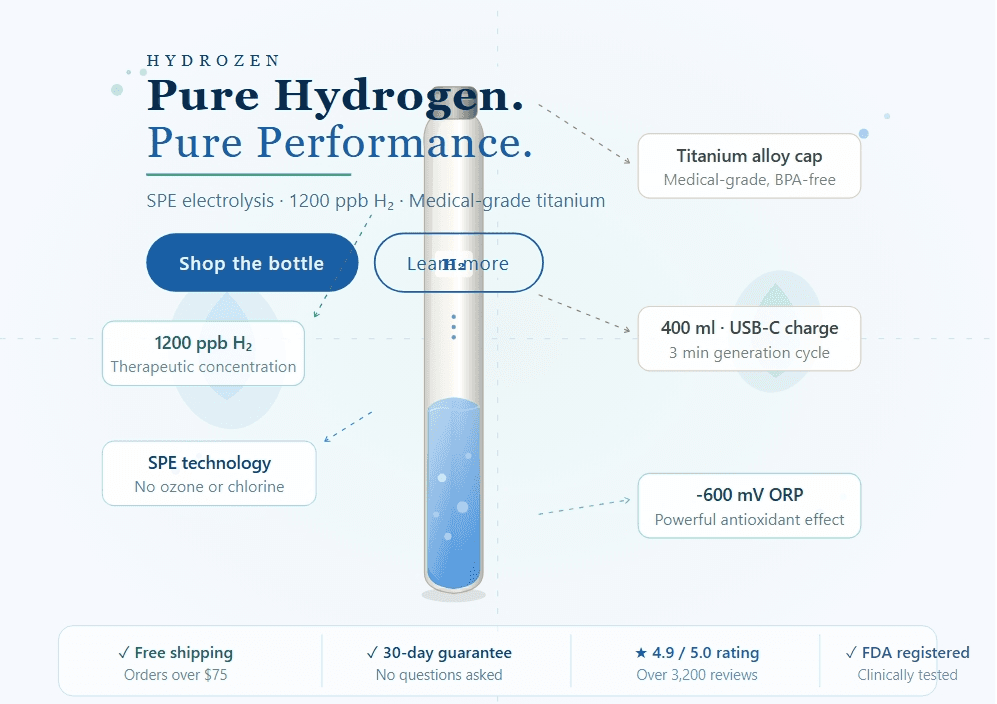
Clear and simple: a device that enhances water with hydrogen for perceived health benefits.
Core Customer Persona:
Health-conscious adults
Fitness enthusiasts
Biohackers
Alternative health followers
Likely skew: mid-to-high income, digitally native
Differentiation:
Primarily branding and positioning
No evidence of:
Proprietary tech
Exclusive manufacturing
Patented features
Commoditisation Risk:
Extremely high
Similar products widely available on Alibaba and Amazon
Ease of Adoption:
High
No behavior change required beyond switching bottles
Repeat Usage Potential:
High usage frequency
Low repurchase frequency (durable good)
Subscription Potential:
Currently underdeveloped
Could be introduced via:
Filters
Hydrogen tablets
Supplements
Price Positioning:
Premium tier ($100+ AOV)
Justified by perceived health benefits rather than production cost
Premium Justification:
Branding
Perceived science
Social proof
Output:
PMF confidence: Moderate–High
Differentiation strength: Weak
Website & Conversion Infrastructure
Website Quality (Inferred):
Likely strong enough to support prior scaling to multi-million revenue
Must have functional CRO baseline
Mobile Optimization:
Likely adequate (given modern Shopify builds), but needs verification
Visual Credibility:
Likely strong due to:
High review volume
Premium positioning
SKU Structure:
Likely limited SKU count
Focus on hero product
AOV:
$139; strong for DTC
Conversion Rate:
Not disclosed
Likely previously optimized via paid traffic
Upsell / Cross-Sell:
Not clearly mentioned
Likely underdeveloped
Bundling Logic:
Opportunity exists but unclear execution
Trust Signals:
Strong (reviews, community, Amazon presence)
Technical Risks:
No obvious red flags disclosed
Checkout Flow:
Likely standard Shopify
Output:
Conversion infrastructure: Good
Quick wins:
Introduce bundles (multi-unit, family packs)
Add subscription layer
Increase UGC density on PDP
Traffic & Distribution Footprint
Traffic Volume:
~57K monthly page views
Primary Channels:
Paid ads (historically dominant)
SEO (recent shift)
Amazon organic
Social media
Facebook group
Channel Concentration Risk:
Historically high reliance on Meta/Google ads
Platform Dependency Risk:
Exposure to:
Meta ad account risk
Google ad volatility
Amazon policy changes
International Reach:
Primarily U.S.
SEO Strength:
Recently prioritized
Likely still developing
Marketplace Presence:
Strong Amazon presence
Direct vs Marketplace:
Mixed
Amazon adds stability but reduces margin
Output:
Traffic fragility: Moderate–High
Channel diversification: Moderate
Marketing & Customer Acquisition
Paid Ads Presence:
Proven historically
Currently reduced
Creative Sophistication:
Likely strong (scaled to high revenue previously)
Funnel Depth:
Includes:
Email
SMS
Retargeting
Email List:
~80K subscribers (very strong asset)
Organic Social:
Moderate presence
UGC Density:
Likely strong due to product type
Influencer Presence:
Not explicitly stated
CAC Indicators:
Unknown (critical missing data)
Scalability Signals:
Demonstrated by past growth
LTV Indicators:
Likely limited due to lack of subscription
Output:
Marketing maturity: Moderate
Scalability: High if CAC remains viable
Monetisation & Unit Economics
Pricing Strategy:
Premium hardware pricing
AOV:
$139
Product Type:
Durable good
Gross Margin (inferred):
Likely 60–70% before ads
37% net margin after expenses
Bundles:
Underutilized
Refund Signals:
0% reported is unrealistic
Subscription Logic:
Missing
Margin Expansion Opportunities:
Subscription
Bundling
Price optimization
Output:
Economic health: Good
Monetisation sophistication: Low–Moderate
Brand Strength & Perception
Brand Consistency:
Likely cohesive across channels
Positioning:
Functional (health benefits)
Storytelling:
Moderate
Founder Visibility:
Low
Review Sentiment:
Strong volume
Needs quality validation
Community Presence:
Strong (Facebook group)
Brand Defensibility:
Weak
Output:
Brand asset strength: Moderate
Reputation risk: Medium
9. Competitive Landscape
Competitor Count:
High
Competitor Strength:
Mix of:
Low-quality dropshippers
Mid-tier brands
Pricing Tiers:
Wide range
Differentiation Gaps:
Opportunity in:
Brand
Education
Community
Switching Cost:
Very low
Barriers to Entry:
Minimal
Race-to-the-bottom Risk:
High
Output:
Competitive intensity: High
Positioning opportunity exists but requires execution
Operational Complexity
SKU Complexity:
Low
Supply Chain:
China-based supplier
Supplier Risk:
Potential single-point dependency
Regulatory Exposure:
Moderate (health claims)
Fulfillment:
3PL-based
Returns Burden:
Unknown
Cash Flow Sensitivity:
Moderate (inventory required)
Output:
Operational risk: Moderate
Scalability friction: Low–Moderate
Risk & Fragility Signals
Key Risks:
Category risk (trend + regulation)
Paid acquisition dependency
Lack of defensibility
Potential hidden product quality issues
Platform dependency
Output:
Fragility index: High
Growth Levers
Actionable Opportunities:
Reintroduce paid ads with improved creative strategy
Launch subscription products
Expand into adjacent wellness products
Build content/media brand around hydrogen health
Enter retail/wholesale channels
Founder & Operator Signals
Founder Role:
Strategic oversight only
Systems:
Team in place
Dependency:
Not founder-heavy
Output:
Operator dependency risk: Low–Moderate
Exit & Optionality
Strategic Appeal:
Moderate
Roll-up Potential:
High
Multiple Expansion Potential:
Limited without moat
Output:
Exit attractiveness: Moderate
Unfair Advantage Check
Existing Advantages:
Email list
Facebook group
Ad learnings
Missing Advantages:
IP
Supply chain control
Proprietary tech
16. Financial Snapshot
Revenue Trend:
Declining post-ad reduction
Profit Stability:
Maintained via lean operations
Multiple Fairness:
Attractive but risk-adjusted
Conclusion:
Business is under-optimized rather than failing
Key Unknowns to Validate
Critical diligence questions:
CAC and ROAS history
True refund and defect rates
Supplier contracts and exclusivity
Ad account performance data
Monthly revenue breakdown
Contribution margins
Reason for scaling down ads
18. Preliminary Verdict
Opportunity Level: Moderate to High (conditional)
Risk Level: High
Investment Profile:
Turnaround and growth play
Final Assessment
This asset has real traction, proven demand, and operational structure. However, it lacks defensibility and sits in a trend-sensitive category.
The upside depends heavily on execution in paid media, LTV expansion, and brand building. Without that, the business is likely to plateau or decline.
This is best suited for an operator with strong marketing capability, not a passive investor.