
Overview
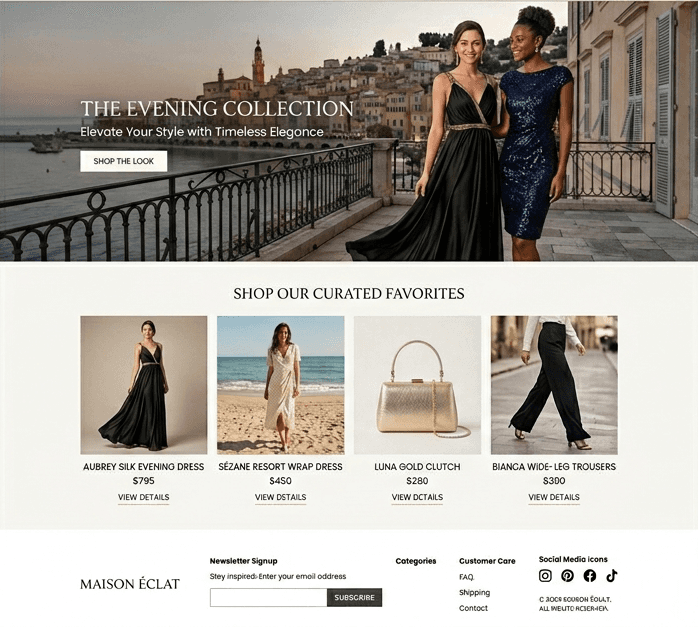
This is a UK-based DTC fashion brand specializing in luxury-inspired women’s apparel, including eveningwear and resort-ready collections. Operating on Shopify with a hybrid fulfillment model combining semi-dropshipping and selective self-fulfillment, the business maintains low operational overhead while delivering high-margin unit economics. It presents a growth opportunity for investors or digital marketers seeking an early-stage fashion DTC brand with organic traction.
The brand benefits from a curated catalog targeting aspirational, style-conscious consumers and an average order value of $98–$114. Early-stage operational systems, an email list, and influencer partnerships are included, making it transferable to a new owner. Initial upside exists in scaling paid acquisition and expanding into international markets.
Market & Demand
The business operates in the global luxury women’s fashion segment, encompassing eveningwear, beachwear, and lifestyle apparel. Growth is fueled by rising disposable income, social media influence, and demand for occasion-driven purchases. Search trends for related keywords show consistent global interest, particularly in the US and EU, indicating untapped demand. While seasonal peaks exist, core demand is evergreen, and influencer-driven trends amplify engagement. The category is discretionary, making it somewhat sensitive to economic downturns, but regulatory barriers are minimal.
Market attractiveness is strong, with demand durability considered moderately high due to a stable core market amplified by fashion trends.
Product–Market Fit
The brand’s value proposition centers on European-inspired luxury fashion at accessible premium prices, appealing to women aged 18–50 who are socially active and fashion-conscious. Differentiation is primarily brand-driven, leveraging a cohesive “aspirational lifestyle aesthetic,” curated collections, and premium presentation. Product adoption is smooth, reinforced by a reported 0% refund rate. Repeat purchases are moderate, relying on new collections and seasonal drops rather than structured retention. Pricing sits in the affordable-luxury tier, justified by perceived quality and styling rather than proprietary product innovations.
Confidence in early-stage product–market fit is moderate to high, though defensibility remains limited.
Website & Conversion Infrastructure
The Shopify store maintains a premium aesthetic aligned with brand positioning, but conversion infrastructure is underdeveloped. Mobile and UX standards are adequate but not optimized for scaling. The most significant bottleneck is trust, reflected in a low Trustpilot score of 2.5/5, which may reduce paid acquisition performance. Upselling, bundling, and advanced funnel strategies are limited, and there is minimal integration of user-generated content or video reviews. Key opportunities for improvement include rebuilding trust signals, adding UGC, implementing bundles, improving product storytelling, and clarifying guarantees.
Overall, conversion infrastructure is rated moderate to weak.
Traffic & Distribution
Traffic is largely organic and influencer-driven, with approximately 500K monthly social media impressions and a modest follower base. Paid acquisition is minimal, suggesting low customer acquisition cost but underdeveloped growth channels. International reach is currently limited to a single market, creating both a weakness and an opportunity for expansion into the US, EU, and Australia. SEO and marketplace presence are underdeveloped, leaving room to diversify traffic sources.
Traffic fragility is high, and channel diversification is low to moderate.
Marketing & Customer Acquisition
Marketing has primarily relied on organic social content and influencer partnerships. Paid campaigns have been tested with strong ROAS (4–7x) but have not been scaled. The email list (~2,200 subscribers) is underutilized, with minimal lifecycle automation. While UGC and influencer engagement are present, marketing systems remain immature, limiting predictable growth. Overall, marketing maturity is low to moderate, but the brand shows high potential if systems are professionalized.
Monetization & Unit Economics
Pricing is in the accessible-luxury range ($80–$150), yielding a reported 44% net margin and an estimated 60–75% gross margin. Average order value is healthy, but revenue per visitor is likely below potential due to limited upsells, bundles, and lack of subscription logic. The 0% reported refund rate supports perceived product quality but conflicts with low trust scores, requiring validation. Monetization sophistication is low to moderate, but structural unit economics are strong and under-optimized.
Brand Strength & Perception
The brand’s visual identity and aspirational positioning are cohesive, appealing to lifestyle-conscious consumers. Storytelling depth is limited, with minimal founder visibility and no notable press or partnerships, reducing perceived authority. Trust issues, particularly the low Trustpilot score, are the largest credibility concern. Community engagement exists but remains shallow, and defensibility is weak given the easily replicable aesthetic.
Competitive Landscape
The luxury-inspired fashion DTC space is highly saturated, with numerous competitors operating at larger scale with stronger logistics, paid media, and content systems. Differentiation gaps include lack of proprietary designs, minimal heritage, and low switching costs for consumers. While the category trends toward mid-premium pricing, margin compression is possible unless brand equity is strengthened. Strategic opportunities include elevating storytelling, faster fulfillment, and focusing on niche subcategories such as resort or event wear.
Competitive intensity is high, and positioning gaps exist in branding and operational execution.
Operational Complexity
Operations are lightweight due to hybrid fulfillment. SKU complexity is moderate, and reliance on a small number of suppliers introduces fragility. Cash flow is favorable given low inventory requirements, but scaling may necessitate inventory investment and international logistics management. Returns, quality consistency, and shipping expectations present moderate operational risks. Overall operational risk is moderate, with scalability friction points in supplier reliability, shipping speed, and quality at scale.
Risk & Fragility
Revenue depends heavily on organic social channels and influencer marketing, creating vulnerability to platform changes. The brand has no structural moat, is easily replicable, and trend-sensitive. Fragility is high, with top risks including weak defensibility, trust/reputation misalignment, and concentration of traffic sources.
Growth Levers
Expansion opportunities include scaling paid acquisition, entering US/EU/Australia markets, launching new collections and accessories to increase AOV, optimizing conversion through trust and UGC improvements, and strengthening brand storytelling to elevate luxury perception.
Founder & Operator Signals
The business requires minimal founder involvement (5–10 hours/week) and is largely system-driven. Execution systems and processes are underdeveloped, making operator dependency moderate.
Exit & Optionality
This brand represents an early-stage build-and-scale opportunity. Strategic appeal increases with strengthened branding and revenue scaled toward $500K–$1M+. The current low multiple (0.6x profit) allows for potential multiple expansion with growth and professionalization. Exit attractiveness is moderate to high.
Financial Snapshot
Revenue growth trajectory is unclear, and reported slowdown should be validated. Profitability is strong and represents the key financial strength of the business.
Conclusion
This is a high-margin, early-stage luxury-fashion DTC brand with proven organic traction, untapped international demand, and strong monetization potential. Key challenges include weak trust/reputation, limited defensibility, concentrated traffic sources, and immature marketing systems. Success depends on trust-building, professionalized acquisition systems, and international scaling. With execution, significant upside exists.
Opportunity Level: Asymmetric
Risk Level: High
Recommended Approach: High-priority acquisition with structured growth plan