
Executive Snapshot
Business model: DTC digital education eCommerce
Primary product category: EMT certification study materials and exam-prep bundles
Geography focus: Primarily U.S. English-speaking market with international digital reach
Initial Investment Thesis
This is a highly lean, asset-light digital education business operating in an evergreen healthcare certification niche with minimal operational complexity. The business benefits from strong margins, no inventory exposure, automated fulfillment, and a practical product tied to career advancement rather than discretionary entertainment spending.
The valuation appears unusually low relative to trailing profit, creating potential upside if earnings quality is verified and customer acquisition channels are stable. Expansion opportunities through upsells, subscriptions, practice exams, SEO, and institutional partnerships provide clear scalability pathways.
Initial Concern Flags
The business is extremely young (<1 year), which limits confidence in revenue durability and makes the earnings profile less proven. Revenue volatility across months also suggests possible dependence on paid traffic or seasonality tied to exam cycles.
Additional diligence is required around:
Traffic source concentration
Sustainability of acquisition costs
Refund/chargeback history
Intellectual property ownership of educational content
Accuracy of claimed “passive” operational structure
Overall, this appears to be a potentially attractive acquisition if traffic quality, ad economics, and content defensibility are validated during due diligence.
Market & Demand Signals
The EMT education and certification-prep market sits within the broader healthcare workforce training industry, which continues to benefit from persistent labor shortages, aging populations, and growing emergency medical service demand. Unlike trend-driven consumer products, EMT certification is tied directly to career entry and mandatory licensing requirements, making demand structurally durable rather than discretionary.
Search behavior for EMT-related keywords tends to remain consistent year-round with predictable spikes around academic enrollment periods and certification exam windows. Terms such as “EMT study guide,” “NREMT prep,” and “EMT practice test” reflect high-intent traffic because users are actively preparing for exams tied to employment outcomes. This creates a strong conversion environment compared to broader education niches.
The category also benefits from several macro tailwinds:
Continued healthcare staffing shortages
Expansion of emergency response infrastructure
Increased vocational education demand
Preference for digital self-paced learning tools
Importantly, the product solves an urgent, outcome-oriented problem: passing certification exams efficiently. This places the business closer to professional utility software than optional education content.
Regulatory risk is relatively low because the business supports exam preparation rather than issuing certifications directly. However, curriculum updates from EMT licensing bodies may require occasional content maintenance.
The niche is fundamentally evergreen. EMT training will continue to exist regardless of consumer trends, economic cycles, or social media shifts.
→ Market attractiveness score: Strong
→ Demand durability assessment: High durability with predictable long-term demand and moderate seasonality tied to training cycles.
Product–Market Fit Indicators
The value proposition is immediately understandable: concise, structured EMT study materials designed to help students pass certification exams faster and more efficiently. The offer targets a clearly defined customer persona, aspiring EMTs and early-career emergency medical professionals who value speed, clarity, and exam-focused learning.
Product-market fit appears relatively strong because the product addresses a high-stakes outcome tied directly to employment and certification. Buyers are not casually browsing; they are motivated individuals seeking practical tools to reduce study time and improve exam success rates. This creates naturally high purchase intent.
Differentiation comes primarily from:
Focused EMT specialization
Bundled digital study resources
Convenience and time-saving positioning
Instant-access digital delivery
Simplified exam-prep structure
However, defensibility is moderate rather than exceptional. Educational content can be replicated, and there is limited evidence of proprietary IP, accreditation, or community/network effects. The moat likely depends more on brand positioning, SEO rankings, customer trust, and funnel optimization than unique content alone.
Customer adoption friction is low because the offer is inexpensive relative to career outcomes and requires no onboarding complexity. The fully digital model also supports strong margins and scalability.
Weaknesses include limited repeat purchase behavior because EMT certification is generally a one-time milestone. That said, expansion into advanced certifications, continuing education, quizzes, flashcards, and subscriptions could improve LTV and retention.
The pricing strategy appears positioned in the mid-premium range for digital exam-prep resources, which is justified if the materials demonstrably improve pass rates or save study time.
→ PMF confidence level: Moderately High
→ Differentiation strength: Moderate with scalable brand and funnel upside but limited structural moat.
Website & Conversion Infrastructure
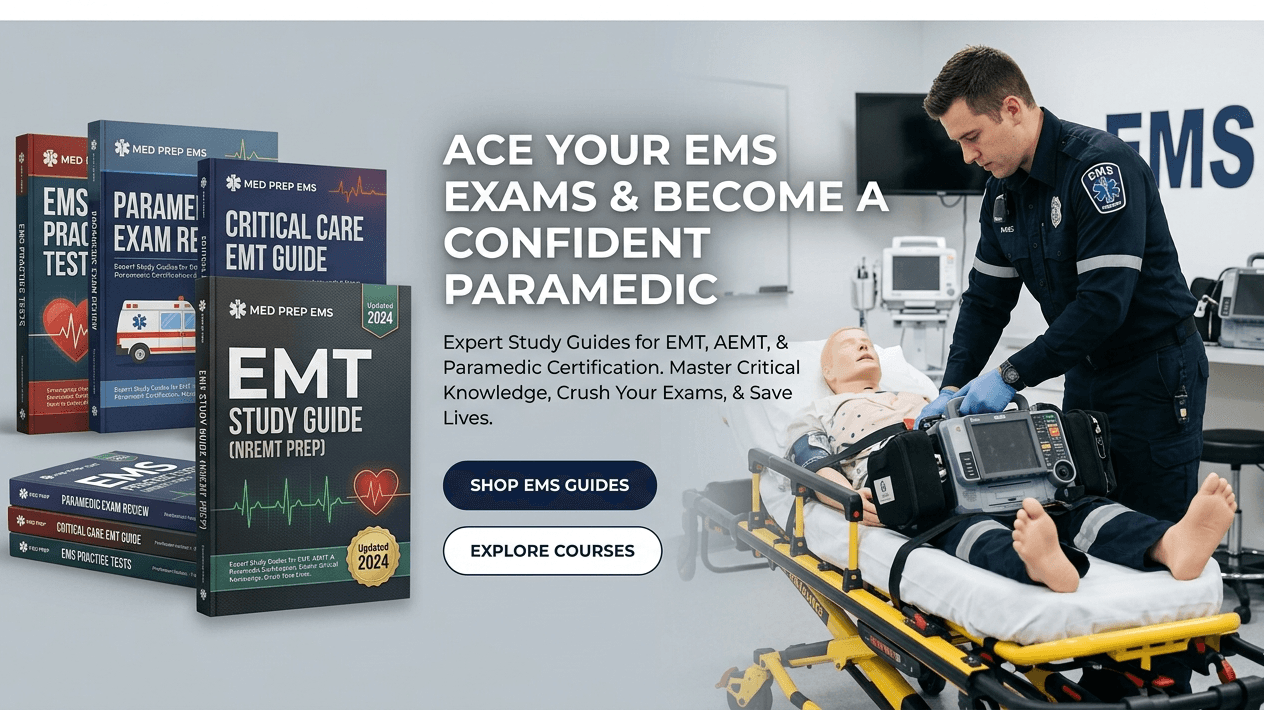
The storefront appears intentionally simple and conversion-focused, which aligns well with the single-product digital education model. The site architecture minimizes friction by concentrating user attention on a core bundled offer rather than overwhelming visitors with a large catalog.
The product page at The Complete EMT Study Bundle uses a direct-response structure emphasizing:
Outcome-driven messaging
Immediate utility
Digital convenience
Simplified purchase flow
The digital-only model significantly improves checkout efficiency because there are no shipping calculations, fulfillment delays, or inventory-related barriers. Automated delivery further strengthens customer experience and operational scalability.
The business likely benefits from a relatively strong AOV due to the bundled pricing structure. Bundling also improves perceived value while reducing decision fatigue. Upsell potential exists through:
Practice exams
Flashcards
Continuing education products
Subscription study libraries
Mobile app access
Mobile optimization is especially important in this category because younger vocational learners often purchase directly from mobile devices. The current Shopify infrastructure likely provides acceptable baseline mobile responsiveness and payment functionality.
Trust-building appears functional but not deeply optimized. Opportunities likely exist to strengthen:
Testimonials and verified student outcomes
Pass-rate statistics
User-generated reviews
Instructor credibility
Social proof density
Potential concerns:
Limited SKU diversification
Heavy dependence on one hero product
Minimal visible brand authority signals
Unknown page speed performance
Unknown email capture sophistication
Output
→ Conversion infrastructure rating: Moderate to Strong
→ Quick-win optimization opportunities:
Add stronger testimonial systems
Improve email capture funnels
Introduce order bumps and upsells
Increase authority signals and proof elements
Expand product ladder beyond one core bundle
Traffic & Distribution Footprint
The business appears to rely primarily on direct-to-consumer traffic through its Shopify storefront, with acquisition likely split between organic search and paid advertising. Because the niche targets high-intent certification seekers, SEO has the potential to be a meaningful long-term acquisition channel if content depth and keyword coverage are sufficiently developed.
The strongest traffic advantage is keyword intent quality. Searches related to EMT certification prep typically indicate immediate exam preparation needs rather than passive browsing behavior, which can support strong conversion efficiency.
However, channel diversification currently appears limited. There is no visible indication of:
Marketplace distribution (Amazon, Udemy, Etsy)
Strong YouTube presence
Large-scale social community ownership
Institutional partnerships
Affiliate ecosystems
This creates moderate channel concentration risk. If a large portion of revenue depends on Meta or Google paid ads, margins could compress quickly under rising CAC conditions.
International scalability exists because the product is fully digital and English-language accessible, but the core TAM is still largely U.S.-centric due to EMT licensing structures.
SEO upside remains significant if expanded through:
EMT exam blogs
NREMT keyword clusters
Free study resources
Practice test landing pages
YouTube educational content
The absence of inventory and logistics constraints makes traffic scaling operationally straightforward. The primary bottleneck is likely acquisition efficiency rather than fulfillment capacity.
Output
→ Traffic fragility score: Moderate
→ Channel diversification strength: Weak to Moderate
Key risk factors:
Possible dependence on one acquisition channel
Limited ecosystem diversification
Young domain authority profile
Key strengths:
High-intent traffic niche
Strong organic content potential
Fully scalable digital delivery infrastructure
Marketing & Customer Acquisition
The current marketing setup appears functional but relatively early-stage rather than highly sophisticated. The business likely relies on a combination of basic paid advertising, direct-response product pages, and organic search traffic rather than a deeply engineered lifecycle marketing system.
The niche itself is favorable for paid acquisition because EMT certification seekers have strong intent and clear pain points. This can support efficient CAC economics if ad creatives and landing pages are optimized effectively. However, there is limited evidence of advanced funnel infrastructure such as:
Multi-step email nurturing
Retargeting segmentation
Webinar funnels
Community-building systems
Content-led acquisition engines
Creative sophistication appears moderate. The offer itself does much of the conversion work because the outcome is career-oriented and practical. This reduces the need for highly emotional or trend-based marketing creative.
The largest scalability opportunity lies in building a stronger owned audience ecosystem:
Email newsletters
Free study resources
YouTube educational content
SEO-driven content funnels
Practice test lead magnets
Certification reminder sequences
LTV is currently constrained by the one-time purchase model. Introducing recurring subscriptions, continuing education products, or advanced EMS certifications could materially improve customer lifetime value and acquisition economics.
UGC and influencer leverage appear underdeveloped, though partnerships with EMT creators, instructors, or training schools could become powerful low-CAC acquisition channels.
Overall, the business appears operationally efficient but commercially underbuilt, which can be positive for an acquirer seeking upside through professionalized growth systems.
Output
→ Marketing maturity level: Moderate but early-stage
→ Scalability assessment: Strong potential if acquisition systems, email infrastructure, and recurring monetization layers are expanded successfully
Monetization & Unit Economics (Surface-Level)
The economics are structurally attractive because this is a pure digital education business with effectively zero inventory, shipping, or fulfillment costs. Gross margins should theoretically exceed 80–90%, yet reported net margins average ~35%, implying significant customer acquisition spend or aggressive ad scaling.
The P&L reveals volatility:
Jul–Sep 2025 showed strong profitability (51–56% margins)
Dec 2025 and Jan 2026 margins compressed sharply (~15–17%)
Recovery occurred in Feb–Mar 2026
This pattern suggests inconsistent paid media efficiency rather than operational weakness. Revenue grew from $27k–35k/month into $45k–55k peaks, indicating scalable demand, but acquisition costs likely increased materially during scale attempts.
AOV appears healthy because the business centers around bundled digital study products instead of low-ticket downloads. The bundle-first strategy reduces purchase friction and increases revenue efficiency.
Monetization sophistication is still relatively basic:
Mostly one-time purchases
Limited visible recurring revenue mechanics
No obvious certification ladder monetization
Minimal evidence of aggressive upsells/order bumps
Margin expansion opportunities:
SEO replacing paid traffic
Subscription study portal
Advanced EMS certifications
Institutional licensing
Email upsell sequences
→ Economic health estimate: Strong underlying economics with moderate acquisition volatility
→ Monetization sophistication: Moderate, with substantial optimization upside
Brand Strength & Perception
The brand currently behaves more like a functional utility product than a deeply emotional education brand. Positioning is practical, convenience-driven, and outcome-oriented: helping EMT students pass exams efficiently.
Brand consistency across the site appears acceptable, but storytelling depth is limited. There is little visible founder narrative, mission positioning, or community identity that creates emotional attachment. This weakens long-term defensibility but also means the brand is not overly dependent on a creator personality.
The strongest trust element is category relevance itself. EMT certification is a serious professional milestone, which naturally creates credibility if the product delivers utility. However, visible authority signals appear underdeveloped:
Limited third-party validation
Unknown review density
No major partnerships visible
No accreditation advantage
Minimal public community presence
The brand’s defensibility currently comes more from execution and search intent capture than emotional loyalty.
→ Brand asset strength: Moderate
→ Reputation risk flags:
Limited public proof ecosystem
Weak emotional differentiation
Low institutional authority visibility
Competitive Landscape
The EMT exam-prep category is moderately crowded but fragmented. Competitors include:
Independent EMT study brands
Quiz/practice-test providers
YouTube educators
Broader healthcare education platforms
Free community resources
The biggest competitors likely possess:
Larger SEO footprints
Stronger content libraries
Established educational authority
Multi-format learning ecosystems
However, the niche remains attractive because customers are highly outcome-focused rather than heavily brand loyal. Switching costs are low, but purchase intent is strong enough that effective positioning and conversion optimization still matter significantly.
Barriers to entry are relatively low:
Content can be replicated
Shopify setup is simple
Digital fulfillment is commoditized
This creates long-term replication risk. The business is not protected by patents, accreditation, or proprietary technology.
Importantly, the category does not appear to be a pure race-to-the-bottom pricing market because buyers prioritize passing exams over finding the absolute cheapest product.
→ Competitive intensity rating: Moderate to High
→ Positioning gap opportunities:
Stronger authority branding
Interactive learning tools
Subscription certification ecosystem
Mobile-first study experience
Operational Complexity (Inferred)
Operational complexity is exceptionally low relative to revenue scale. The business has:
No physical inventory
No logistics infrastructure
No supplier dependency
Minimal fulfillment burden
Low customer support intensity
The SKU structure appears highly concentrated around one core bundle, which simplifies operations substantially.
Regulatory exposure is relatively limited because the company provides educational materials rather than medical services or accredited certification programs. The primary operational requirement is maintaining curriculum relevance.
Cash flow characteristics are highly favorable:
Immediate payment collection
No inventory financing
Minimal working capital needs
The model scales efficiently because incremental customers create almost no marginal fulfillment cost.
→ Operational risk score: Low
→ Scalability friction points:
Content updating requirements
Customer acquisition scalability
Increasing support volume at scale
Risk & Fragility Signals
The largest structural weakness is concentration risk.
The business appears heavily dependent on:
A single core product
Potentially one or two acquisition channels
A very young operating history
The short lifespan (<12 months) makes earnings durability difficult to assess. There is insufficient evidence yet that current performance can survive platform changes, CAC inflation, or competitive pressure.
Replication risk is also meaningful because educational PDFs and study guides are easy to imitate. Without stronger brand equity or community ownership, competitors could compress pricing over time.
Platform dependency risk may also exist if:
Meta ads drive most sales
SEO rankings drive majority traffic
Shopify/payment processors represent key infrastructure
→ Fragility index: Moderate to High
→ Top 3 structural risks:
Acquisition channel concentration
Easy-to-copy educational content
Insufficient operating history
Growth Levers (Externally Visible)
Actionable Growth Hypotheses
Build Certification Ladder Products
Expand into paramedic prep, advanced EMS training, continuing education, and refresher certifications to increase LTV.Launch Subscription Learning Hub
Introduce recurring revenue through practice exams, quizzes, flashcards, AI tutoring, and updated study content.SEO Content Expansion
Scale organic traffic with NREMT blogs, exam tips, free study resources, and YouTube education content.Institutional Partnerships
Partner with EMT schools and vocational programs for bulk licensing or referral partnerships.Increase Conversion Sophistication
Deploy email nurturing, retargeting, upsells, order bumps, and segmented funnels to improve monetization efficiency.
Founder & Operator Signals
The business appears operator-efficient but not deeply systemized publicly. Signals indicate:
Practical execution
Lean operating structure
Simple monetization model
Fast deployment capability
There is limited founder-centric branding, which is positive for transferability. However, lack of visible systems documentation or team structure creates uncertainty around operational maturity.
The business currently looks more like a strong niche digital product than a fully institutionalized education company.
→ Operator dependency risk: Moderate
Exit & Optionality Signals
This asset is more attractive as a cash-flow acquisition or bolt-on roll-up target than as a premium standalone brand today.
The low acquisition multiple creates asymmetric upside if:
Revenue stabilizes
Traffic becomes diversified
Recurring revenue is introduced
Brand authority strengthens
Scale improves:
Content leverage
SEO economics
Cross-sell efficiency
Email monetization
Scale may worsen:
Paid acquisition efficiency
Support complexity
Competitive visibility
→ Exit attractiveness score: Moderate to Strong
“Unfair Advantage” Check
Current unfair advantage is limited.
Potential advantages:
Existing revenue momentum
Search positioning
Conversion-tested offer
Focused niche specialization
What cannot easily be replicated in 12 months:
Existing customer data
Funnel learnings
Historical ad data
Existing revenue proof
However, there is no obvious:
Proprietary IP moat
Community moat
Technology moat
Distribution monopoly
Financial Snapshot (Preliminary Review)
Revenue trend shows rapid scaling but inconsistent profitability.
Key observations from P&L:
Revenue accelerated materially after launch
Profit margins fluctuated aggressively
Q4 expenses surged disproportionately
Jan profitability collapsed before recovering
This strongly implies variable ad-spend intensity rather than operational instability.
The 1.1x profit multiple is unusually cheap if earnings are legitimate and durable. Comparable digital education assets often transact materially higher.
Potential anomaly:
Business may be optimized for sale via temporary ad scaling or aggressive revenue acceleration.
Further verification is essential.
Key Unknowns to Validate in Seller Call
Critical diligence questions:
Monthly traffic breakdown by source
Paid vs organic revenue mix
CAC and blended ROAS
Actual refund and chargeback rates
Email list size and conversion rates
Returning customer percentage
Exact ad spend history
Revenue concentration by SKU
Content ownership/IP verification
Why margins compressed in Dec–Jan
Reason for selling so early
Copycat competition issues
Team/process documentation
Any dependency on freelancers/agencies
Preliminary Verdict
Opportunity Level: Asymmetric
Risk Level: Moderate to High
Investment Profile
Cash-flow play
Digital asset arbitrage
Growth optimization opportunity
Potential roll-up candidate
Recommendation
Schedule seller call
This is attractive primarily because:
Valuation is unusually low
Operations are extremely lean
Healthcare education is evergreen
Digital margins are structurally excellent
Significant optimization upside exists
However, conviction should remain cautious until:
Traffic quality is verified
CAC sustainability is confirmed
Revenue durability is proven
Content moat is evaluated
Operational systems are validated
If the numbers are real and acquisition channels are reasonably diversified, this could represent a strong asymmetric acquisition with relatively fast payback potential.