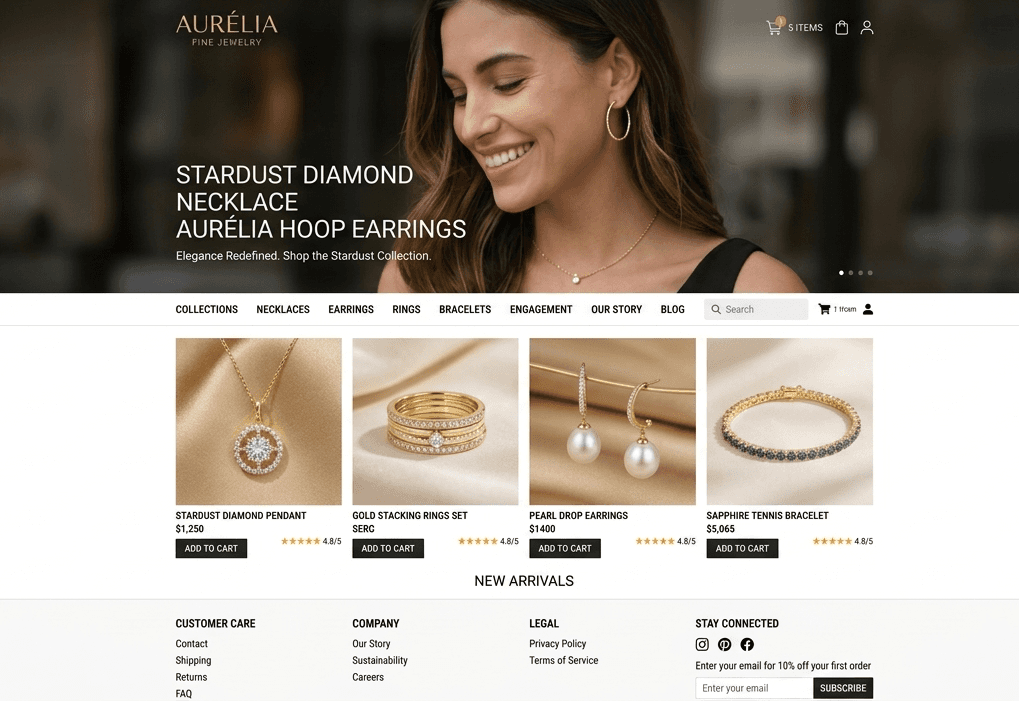

Business Overview
This e-commerce business operates as a brand-led online jewelry store targeting U.S. consumers. The business focuses on jewelry products that appeal to emotionally driven purchases such as gifts, relationship milestones, and self-expression.
The founders intentionally positioned the brand in an evergreen category with stable consumer demand, aiming to build a scalable ecommerce asset rather than a single-product trend store.
Key strategic elements include:
Professional brand presentation
Broad product catalog that can expand easily
Marketing-driven growth model
Automated fulfillment infrastructure
This positioning allows the company to scale primarily through marketing optimization rather than operational complexity.
Business Model
Direct-to-Consumer Ecommerce
The business operates using a Shopify-based DTC model with the following structure:
Customers purchase products directly from the website
Orders are automatically forwarded to suppliers
Suppliers fulfill orders directly to customers
Key advantages
No inventory holding
Minimal operational workload
High flexibility for testing products
Scalable advertising-driven growth
Revenue generation is driven primarily by paid acquisition, particularly Meta advertising.
Marketing & Customer Acquisition
The primary growth engine of the business is paid digital advertising.
Core channels
1. Meta Ads (Primary Driver)
Facebook and Instagram ads are used to test new creatives, audiences, and offers.
2. Google Ads
Used to capture intent-based search traffic.
Marketing strategy
Continuous creative testing
Scaling winning campaigns
Audience optimization
Offer testing
Product experimentation
Untapped opportunities
The listing indicates growth potential through:
TikTok ads
Influencer marketing
Pinterest traffic
User-generated content
Short-form video advertising
Operations
Daily operations are relatively lightweight due to automation.
Typical weekly tasks
Monitor ad performance
Adjust campaign budgets
Test new creatives
Monitor store metrics
Handle limited customer support inquiries
Because fulfillment is outsourced, the owner primarily focuses on marketing and growth decisions rather than logistics.
Fulfillment & Supply Chain
The business operates using a fully automated dropshipping fulfillment system.
Workflow
Customer places order on Shopify
Order automatically sent to supplier
Supplier prepares and ships product
Tracking information syncs back to Shopify
Customer receives shipment
Benefits
No inventory risk
No warehouse costs
No inventory financing
Predictable operational costs
The supplier handles:
Product preparation
Packaging
Shipping logistics
Inventory
The business does not hold inventory.
Key implications:
No capital tied up in stock
No unsold inventory risk
Easier cash flow management
Ability to test new products quickly
This structure keeps the business lean and asset-light.
Financial Performance
Annual Financial Summary
Metric | Value |
Annual Revenue | $1,949,786 |
Annual Profit | $362,855 |
Average Monthly Revenue | $162,482 |
Average Monthly Profit | $30,237 |
Profit Margin | 19% |
Financial Trend Observations
Early 2025 shows strong monthly revenue between $160k–$245k, but performance declines sharply after September 2025.
Possible explanations include:
Reduced ad spend
Creative fatigue
Strategic focus shift by founders
Advertising account issues
Seasonality or scaling limitations
This trend requires deeper due diligence before acquisition.
Assets Included in the Sale
The purchase includes all major business assets required to operate and scale the store:
Digital assets
Domain name
Brand logo
Website and theme files
Website source code
Product images and videos
Marketing assets
Meta advertising accounts
Social media accounts
Creative assets
Customer data
287,601 customer records
Customer service email access
Supplier infrastructure
Supplier contact details
Fulfillment integration setup
Transition support
After-sale support from founders
Growth Opportunities
The business has several clear paths for scaling.
1. Creative expansion
Increasing the volume of advertising creatives can:
Reduce ad fatigue
Improve conversion rates
Lower acquisition costs
2. New traffic channels
Potential channels include:
TikTok ads
Pinterest
Influencer marketing
Affiliate programs
3. Product expansion
Introducing:
Complementary jewelry products
Bundles
Gift sets
Limited collections
4. Increasing AOV
Through:
Upsells
Cross-sells
Bundled offers
Investment Assessment
Key Strengths
Proven revenue history near $2M annually
Strong profit margin for dropshipping (19%)
Fully automated fulfillment
Large customer list (287k+ customers)
Extremely low acquisition price relative to historical profit
No inventory risk
Key Risks
Recent decline in revenue and profits
Heavy reliance on paid ads
Dropshipping quality control risks
Potential advertising account dependency
Limited brand moat
Preliminary Valuation Perspective
At an asking price of $125,000, the deal represents:
0.1× revenue
0.3× profit
This is significantly below typical ecommerce acquisitions (usually 2–4× profit), suggesting either:
A distressed sale
Reduced confidence in sustainability
Performance drop in recent months
Traffic/account dependency risk
Summary
Timeless Treasures is a lean, marketing-driven ecommerce jewelry business with nearly $2M in annual revenue and automated operations. The extremely low valuation presents potential upside if traffic and marketing performance can be stabilized or scaled.
However, the recent decline in performance and heavy reliance on paid ads require careful due diligence before acquisition.
Market & Demand Signals
Timeless Treasures operates in the fashion jewelry ecommerce market, a large and established consumer category driven by gifting culture, fashion trends, and personal expression. Jewelry is one of the most resilient segments within the fashion accessories industry because it is tied to emotionally significant events such as relationships, celebrations, and milestones.
The global jewelry market exceeds $350 billion and is projected to grow steadily over the next decade, with ecommerce becoming an increasingly dominant distribution channel. Online jewelry sales are expanding faster than traditional retail due to rising mobile shopping, social media discovery, and influencer-driven purchasing behavior. The United States, the brand’s primary market, represents one of the largest jewelry markets globally.
Search demand indicators show consistent and high-volume interest in jewelry-related keywords, including terms like necklaces, rings, and personalized jewelry. These searches remain stable year-round with predictable spikes during major gifting seasons such as Valentine’s Day, Mother’s Day, weddings, and Christmas. This indicates that jewelry demand is evergreen with seasonal peaks, rather than dependent on short-lived trends.
Although jewelry is a discretionary purchase rather than an essential product, cultural habits around gifting, relationships, and fashion ensure continuous demand even during economic slowdowns. Additional macro tailwinds include increasing ecommerce adoption, social media influence on fashion purchases, the rise of self-purchasing jewelry, and growing interest in personalized accessories.
Regulatory factors such as tariffs or sourcing requirements have limited direct impact on ecommerce retailers compared to manufacturers, meaning market demand remains largely unaffected by policy changes.
Market Attractiveness Score: Strong
Demand Durability Assessment: High. Jewelry represents a timeless consumer category with stable long-term demand and predictable seasonal purchasing cycles, though competition and marketing efficiency play a major role in determining individual brand success.
Product–Market Fit Indicators
Value Proposition Clarity
The e-commerce store offers affordable, stylish jewelry purchased online with convenience and variety, targeting customers seeking fashionable accessories or meaningful gifts. The value proposition can be summarized as: a convenient online destination for trendy, emotionally driven jewelry purchases at accessible prices.
Core Customer Persona
The primary customer segment appears to be women aged 18–45 in the United States, particularly those who:
Purchase jewelry for fashion or self-expression
Buy gifts for partners, friends, or family
Engage with social media trends and influencer-driven products
Prefer affordable luxury rather than high-end designer jewelry
Secondary audiences include men purchasing gift jewelry for partners and customers looking for symbolic relationship items.
Differentiation
Differentiation is primarily brand and marketing-driven rather than product-driven. Since the store operates through a dropshipping model, the core products are likely sourced from common suppliers and may also appear on other ecommerce stores or marketplaces.
Brand positioning, creative advertising, product bundling, and website presentation appear to be the primary differentiators.
Commoditization Risk
Risk of commoditization is high. Jewelry products sold through dropshipping are typically widely available from multiple suppliers, making it relatively easy for competitors to replicate product offerings. Without proprietary designs, exclusive supplier agreements, or strong brand equity, competitive advantages rely heavily on marketing performance.
Ease of Customer Adoption
Adoption barriers are very low. Jewelry is a familiar consumer product, inexpensive relative to luxury alternatives, and easily purchased online. This supports impulse buying and rapid customer acquisition through social media advertising.
Repeat Usage Potential
Jewelry is not consumable, but repeat purchases are common because customers often buy multiple items over time or purchase gifts for different occasions. The presence of a 287,000+ customer list suggests meaningful repeat potential if properly leveraged through email marketing.
Subscription or Refill Logic
There is no inherent subscription or refill model, although curated monthly jewelry boxes or membership discounts could theoretically introduce recurring revenue.
Price Positioning
The brand appears to compete in the mid-to-low price range of fashion jewelry, positioned between mass-market fast fashion jewelry and premium designer pieces.
Premium Justification
There is limited evidence of premium justification beyond branding, styling, and marketing presentation.
PMF Confidence Level: Moderate
Differentiation Strength: Weak to Moderate
Website & Conversion Infrastructure
Website Speed & UX Quality
The store is built on Shopify, which generally provides reliable hosting and acceptable performance. The site structure appears standard for dropshipping ecommerce stores, with clear product pages, product images, and a conventional navigation layout. However, overall user experience may be impacted by brand credibility concerns and weak trust signals, which can negatively affect conversion rates.
Mobile Optimization
Shopify themes are typically mobile-responsive, which is essential since a large portion of ecommerce traffic, especially from social media ads, comes from mobile devices. While the store likely functions adequately on mobile, optimal performance depends on page load speed, simplified navigation, and fast checkout.
Visual Credibility & Brand Consistency
The brand presentation appears relatively polished with a defined aesthetic, but credibility risks exist due to poor third-party reputation signals. A Trustpilot TrustScore of 1.5/5 based on 78 reviews significantly weakens consumer trust and may cause potential customers to abandon purchases.
SKU Count & Catalog Structure
The store appears to operate with a moderate catalog of jewelry products, likely organized into categories such as necklaces, rings, and bracelets. A broad catalog helps increase browsing time and supports higher order values through multiple-item purchases.
Average Order Value (AOV)
While exact figures are not provided, jewelry ecommerce stores typically generate AOV between $40–$120, depending on pricing, bundles, and upsell structure. AOV likely relies on cross-selling complementary jewelry pieces.
Estimated Conversion Rate
Given the low trust score and dropshipping model, the estimated conversion rate may fall within the 1–2% range, which is typical for paid-traffic ecommerce stores in competitive categories.
Upsell/Cross-Sell Structure
Jewelry lends itself well to cross-selling complementary products, such as matching necklaces, bracelets, or rings. However, the effectiveness depends on how well upsells and bundles are integrated into product pages and checkout.
Bundling Logic
Potential bundling strategies include:
Couple jewelry sets
Gift bundles
Multi-item discounts
These can increase AOV and improve ad profitability.
Trust Signals
Trust signals appear weak due to the low Trustpilot score (1.5/5). Negative reviews can significantly harm conversion rates, particularly for new visitors arriving from paid ads.
Technical Issues Visible Publicly
No major technical failures are immediately apparent, but potential concerns include:
Slow loading product pages
Limited authenticity signals
Reputation-related credibility issues
Checkout Flow Friction
Shopify typically provides a streamlined checkout process, but poor brand trust may still cause drop-off during payment.
Conversion Infrastructure Rating: Moderate–Weak
Quick-Win Optimization Opportunities
Improve reputation management and customer satisfaction.
Add stronger trust signals (reviews, UGC, testimonials).
Introduce optimized bundles and upsells to increase AOV.
Strengthen brand storytelling to improve credibility.
Improve customer support visibility and delivery transparency.
Traffic & Distribution Footprint
Estimated Traffic Volume
Based on reported financial performance (approximately $162K average monthly revenue), the store likely generates significant traffic driven primarily by paid advertising. Assuming an estimated ecommerce conversion rate of 1–2% and an average order value between $50–$100, monthly traffic could reasonably fall within the range of 80,000–160,000 visitors per month during active advertising periods. Traffic levels likely fluctuate depending on advertising spend and campaign performance.
Primary Channels
The business relies heavily on paid digital advertising as its main traffic source.
Key channels include:
Meta Ads (Facebook & Instagram) – primary driver of traffic and revenue
Google Ads – captures intent-driven searches and supports conversion
Email marketing – potential channel through a 287,601-customer database, although its current utilization is unclear
There is limited evidence of significant traffic from organic search, influencer partnerships, or social media communities.
Channel Concentration Risk
Channel concentration appears high. The listing indicates that most sales are generated through Meta advertising campaigns, which creates vulnerability if ad performance declines or advertising costs increase.
Platform Dependency Risk
Platform dependency is also high, particularly on Meta’s advertising ecosystem. Ecommerce stores built primarily on Facebook/Instagram traffic often face risks such as:
Rising customer acquisition costs
Advertising account restrictions
Creative fatigue
Algorithm changes
Google Ads likely plays a secondary but supportive role.
International vs Local Reach
The store primarily targets customers in the United States, which simplifies logistics but limits geographic diversification. International expansion could represent a growth opportunity.
SEO Footprint Strength
The SEO presence appears limited, as the business strategy focuses on paid traffic rather than organic discovery. Without a strong content or backlink strategy, organic search traffic likely contributes only a small portion of total sales.
Marketplace Presence
There is no indication of marketplace presence on platforms such as Amazon or Etsy. Sales appear to occur exclusively through the Shopify website.
Direct vs Intermediary Sales
Sales are direct-to-consumer (DTC) via the brand’s website, meaning the company maintains control over customer relationships and data.
Traffic Fragility Score: High
Channel Diversification Strength: Weak to Moderate
Marketing & Customer Acquisition
Paid Advertising Presence
Customer acquisition is primarily driven by paid advertising, particularly through Meta (Facebook and Instagram)campaigns. The marketing strategy focuses on testing multiple creatives, audiences, and offers, then scaling campaigns that perform well. Google Ads is used as a secondary channel to capture high-intent search traffic. There is no clear evidence of large-scale advertising activity on TikTok Ads or other emerging platforms, suggesting paid traffic sources remain relatively concentrated.
Creative Sophistication
The marketing approach appears performance-driven rather than brand-led. Campaigns likely rely on product-focused creatives such as lifestyle imagery, short-form videos, and promotional offers. While this is common in ecommerce jewelry, it indicates moderate creative sophistication rather than highly differentiated storytelling or premium brand campaigns.
Funnel Depth
The marketing funnel appears relatively shallow, focused mainly on direct conversion from paid traffic. There is limited information about advanced funnel infrastructure such as:
Lead magnets
Multi-stage retargeting sequences
Automated email lifecycle campaigns
Loyalty or referral programs
However, the business does have the technical capacity to build these systems.
Email List Size
A significant marketing asset is the customer list of approximately 287,601 contacts. This database provides opportunities for retargeting, promotions, and repeat purchase campaigns, though the extent of current utilization is unclear.
Organic Social Engagement
The listing includes social media accounts, but there is no clear evidence of strong organic engagement or community-building. Social channels appear primarily used to support paid advertising rather than organic growth.
UGC Density
Jewelry brands typically benefit from user-generated content (UGC), but available information suggests that UGC usage is moderate rather than extensive.
Influencer Presence
There is no indication of structured influencer marketing partnerships or affiliate programs.
CAC Indicators
Customer acquisition costs are not disclosed, but the reliance on Meta ads suggests CAC is directly tied to advertising efficiency and creative performance.
Scalability Signals
The automated fulfillment system, paid advertising infrastructure, and large customer list provide clear scalability potential if marketing optimization improves.
LTV Indicators
Repeat purchase potential exists due to the nature of jewelry gifting and fashion purchases, but strong LTV strategies (subscriptions, memberships, loyalty programs) do not appear fully developed.
Marketing Maturity Level: Moderate
Scalability Assessment: Moderate to High, dependent on marketing optimization and channel diversification.
Monetization & Unit Economics (Surface-Level)
Pricing Strategy
The brand operates in the affordable fashion jewelry segment, typically priced to encourage impulse purchases driven by social advertising.
Product Price Bands
Typical dropshipping jewelry stores sell items within:
$20–$40 (entry items)
$40–$80 (core range)
$80–$120+ (bundles or premium items)
Pricing appears positioned as accessible luxury rather than premium jewelry.
Average Order Value (AOV)
Based on estimated revenue and typical category benchmarks:
Estimated AOV: $50–$90.
Implied Gross Margin
Jewelry dropshipping margins usually fall between 60–80% before advertising costs. However, once paid acquisition costs are included, net margins tighten significantly.
The business reports:
Revenue: $1.95M
Profit: $362K
Net Margin: ~19%
This suggests advertising spend is the largest cost center.
Bundles/Upsells
Jewelry naturally supports bundling (matching sets, multi-item discounts). Evidence suggests this exists but is not aggressively optimized.
Return/Refund Signals
The Trustpilot score of 1.5/5 suggests potential issues related to:
delivery delays
product quality
customer service
These may increase refund costs and damage conversion.
Subscription Logic
None currently implemented.
Margin Expansion Potential
Potential margin improvements could come from:
better creative performance
supplier negotiation
improved AOV via bundles
stronger retention marketing
Economic Health Estimate: Moderate but fragile
Monetisation Sophistication: Basic
Brand Strength & Perception
Brand Consistency
The brand presentation appears visually cohesive across the website, but perception issues emerge externally through negative review signals.
Emotional Positioning
The brand leans on emotional gifting positioning, typical for jewelry purchases (relationships, symbolism, self-expression).
Storytelling Depth
Brand storytelling appears lightweight, focused primarily on product presentation rather than a deep brand narrative.
Founder Visibility
No meaningful founder-led brand narrative or public visibility.
Review Sentiment
Trustpilot signals are concerning:
TrustScore: 1.5 / 5
78 reviews
Negative reputation significantly reduces credibility.
Press/Certifications
No evidence of:
media coverage
certifications
influencer endorsements
notable partnerships
Community Presence
Little evidence of a community-driven brand ecosystem.
Brand Defensibility
Low. Without proprietary designs, brand community, or unique positioning, the business functions more like a performance marketing storefront.
Brand Asset Strength: Weak
Reputation Risk Flags: High
Competitive Landscape
Number of Competitors
The fashion jewelry ecommerce category is extremely saturated. Thousands of Shopify stores compete with similar offerings.
Strength of Top Competitors
Strong competitors include:
established DTC jewelry brands
Amazon sellers
Etsy creators
fashion retailers
influencer brands
Many have stronger brand loyalty and social presence.
Pricing Tiers
Market pricing ranges broadly:
Low tier: $10–$30
Mid tier: $40–$100
Premium DTC: $100–$300+
Timeless Treasures appears positioned in the mid-low fashion segment.
Differentiation Gaps
Key differentiation gaps include:
lack of proprietary designs
limited brand storytelling
minimal influencer integration
Switching Cost
Very low. Customers can easily purchase similar jewelry from competitors.
Barriers to Entry
Barriers are minimal because:
suppliers are widely accessible
Shopify infrastructure is easy to replicate
paid ads can scale new entrants quickly
Race-to-the-Bottom Risk
Yes. Fashion jewelry frequently experiences price competition and ad cost pressure.
Competitive Intensity Rating: Very High
Positioning Gap Opportunities: Brand storytelling and influencer positioning
Operational Complexity (Inferred)
SKU Complexity
Moderate. Jewelry catalogs typically contain dozens to hundreds of SKUs.
Supply Chain Dependence
Heavy dependence on dropshipping suppliers introduces risk if:
suppliers change pricing
shipping delays occur
product quality fluctuates
Regulatory Exposure
Low. Jewelry generally has minimal regulatory burden compared to health or cosmetic products.
Fulfillment Intensity
Low because fulfillment is outsourced.
Returns Burden
Potentially moderate given negative customer reviews.
Cash-Flow Sensitivity
Positive aspect: no inventory held, meaning minimal working capital risk.
International Logistics
Limited complexity since the store primarily targets the U.S. market.
Operational Risk Score: Moderate
Scalability Friction Points: Supplier reliability and customer service
Risk & Fragility Signals
Hero SKU Dependency
Unknown but likely multiple products contribute to revenue rather than a single hero item.
Channel Dependency
High reliance on Meta advertising.
Platform Policy Risk
Advertising account suspensions could halt revenue instantly.
Trend vs Evergreen
Jewelry is evergreen, reducing category-level risk.
Brand vs Product Moat
Product moat is weak and easily replicated.
Ease of Replication
Very high. Competitors could replicate the store within weeks.
Legal Exposure
Potential exposure related to:
misleading product claims
supplier quality issues
shipping transparency
Revenue Concentration
Recent financial data indicates significant revenue decline:
Early 2025 revenue:
$160K–$245K monthly
Late 2025–2026 revenue:
$39K–$105K monthly
This suggests the business may be de-scaling or ad spend reduced.
Fragility Index: High
Top 3 Structural Risks
Heavy dependence on paid advertising
Weak brand moat and commoditized products
Reputation damage from poor reviews
Growth Levers (Externally Visible)
1. Product Line Expansion
Introduce:
personalized jewelry
seasonal collections
higher-end product lines
2. Audience Expansion
Expand targeting toward:
gifting audiences
wedding and engagement niches
men’s jewelry
3. Geographic Expansion
Open marketing to:
UK
Canada
Australia
Western Europe
4. Influencer Strategy
Leverage TikTok and creator partnerships.
5. Retention Monetization
Activate the 287k customer list through email and SMS marketing.
Founder & Operator Signals
Founder Visibility
Low public founder presence.
Execution Velocity
The initial growth suggests strong early execution, but recent decline may indicate reduced operational focus.
Professional vs Hobby
The scale suggests professional marketing execution at some stage.
Marketing vs Product Operator
The business appears run by performance marketing operators rather than product designers.
Systems Evidence
Automated fulfillment and ad infrastructure indicate systems exist, though team structure is unclear.
Operator Dependency Risk: Moderate
Exit & Optionality Signals
Strategic Buyer Appeal
Limited unless brand perception improves.
Roll-Up Compatibility
Possible within a portfolio of ecommerce brands.
Brand vs Cashflow Asset
Currently behaves more like a cash-flow asset than a brand asset.
Multiple Expansion Potential
Possible if:
reputation improves
organic traffic grows
marketing diversifies
What Improves with Scale
Ad creative testing and purchasing power with suppliers.
What Worsens with Scale
Customer service complexity and reputation exposure.
Exit Attractiveness Score: Moderate–Low
“Unfair Advantage” Check
Currently there is no clear unfair advantage.
No evidence of:
proprietary IP
exclusive suppliers
community moat
brand cult following
Most assets could be replicated within 6–12 months.
Financial Snapshot (Preliminary Review)
Revenue Trend
Revenue is declining sharply.
Peak months exceed $240K, but recent months dropped below $40K.
Profit Trend
Profit mirrors the decline.
Margin Stability
Net margin remains around 19%, which is acceptable but not exceptional.
Multiple Fairness
The asking price ($125K) equals roughly:
0.34× annual profit
Typical ecommerce multiples:
2×–4× profit
This extremely low valuation suggests either:
deteriorating performance
hidden operational risks
urgency to sell
Possible Sale Optimization
Listing may emphasize historical peak performance rather than current trend.
Key Unknowns to Validate in Seller Call
Critical questions:
Last 6 months revenue breakdown
Actual gross margin
Blended CAC and ROAS
Customer LTV
Refund rate
Supplier contracts and exclusivity
Ad account health
Current advertising spend
Chargeback rates
Customer complaint themes
Exact reason for selling
Team involvement
Biggest operational bottleneck
Preliminary Verdict
Opportunity Level
Moderate
Risk Level
High
Investment Profile
Turnaround opportunity
Recommendation
Proceed with caution
The extremely low price could represent distressed asset pricing, but the declining revenue trend, weak brand moat, and negative reputation signals require careful due diligence before proceeding.